顯示具有 旅行看歷史 標籤的文章。 顯示所有文章

2020年5月26日 星期二

My visit to Japan 2020 – Hiroshima (5)

On the 8th March I received an e-mail from my air-line company saying that my air ticket to depart from Japan was cancelled due to Covid-19. It offered me two options: a) to wait in Hiroshima until early April hoping that the new virus in Japan would be over by then, or b) to get a refund. Obviously, I could not stay in Japan for such a long time. To say the least, my Airbnb accommodation booking would not allow me to do so as it would end on 15th. My only option was to buy an air-ticket in Japan by myself. The next day I tried to contact a local traveling agency in Hiroshima and found the JTB. To my astonishment JTB was a travel agent that only sold ANA airline tickets. The staff of JTB even said that ANA flight schedules to Hong Kong were very limited, probably due to the new virus in Japan. They recommended me to try another local travelling agent, the HIS.
I bought my air ticket from HIS
On the 9th I visited the of office of HIS in Hiroshima to buy a single trip ticket from Japan to Hong Kong. I wanted to leave Japan as early as possible in order to avoid a quarantine in Hong Kong. Hong Kong Government had announced that very soon all incoming visitors to Hong Kong would be subjected to a 14-day quarantine. The staff in HIS was very helpful and suggested me to buy the Cathay Pacific air-ticket. I agreed and it took about 2 hours for me to finish the ticket buying process. My found that it was a new experience for the HST staff to receive a client like me. It was a rare case for a foreigner to buy a single trip ticket in such relatively small town like Hiroshima. The paper work was done very slowly. There were many reasons, for example, the staff had to spend some time to sort out how to position my first name and last name (as indicated in my passport) into my ticket buying documents which was designed for the Japanese clients. This air-ticket buying experience reminded my Japanese language learning experience in my university days.

I learned Japanese in the University of British Columbia (UBC). In the classroom in those days, often there were group learning scenarios in which students had to do role playing. The setting of one scenario was inside a travelling company and the students had to play the role of a customer or a staff. Students had to practice using Japanese vocabularies such as days, months, the city names, the means and purpose of traveling, and the payment amount and method etc. Now, in Hiroshima, all things came into live again and my memories came back to my mind.

At that moment, the Japanese government had already announced that the only airport opened to foreigners were Osaka and Tokyo. Although I wanted to fly back to Hong Kong from Hiroshima where I was staying, I had no choice but to pick Osaka as the departing airport. As such, I had to sort out my trip from Hiroshima to the Osaka International Airport.

One strange thing I noted was about the air ticket price, it could rise suddenly at any time because of the pandemic. The Cathay Pacific single trip air ticket that I bought was 64,000 yen before tax and 70, 100 including tax (about HK$ 6,000). Out of curiosity, I checked the price again the next day on the Internet, it had jumped to about 220,000 yen (about HK$18,000). That was unbelievable.

Bullet train time table from Hiroshima to New Osaka
My airplane would leave Osaka for Hong Kong on the 12th at 6.00 pm. I chose the bullet-train as the means to travel from Hiroshima to Osaka. The average time taken for a bullet train would usually be from 1.30 hours to over two hours, depending how many stops it would make en-route. I picked the fastest one which made only three stops en-route and took 1 hour and 27 minutes. I noted that all the carriages of any one bullet-train had been designed into either reserved seat (指定席) carriage which was more expensive, and the non-reserved seat carriage (自由席) which was cheaper. So, tourists had to wait at the right spot at the platform for the carriage. The waiting spots were clearly marked on the platform floor.
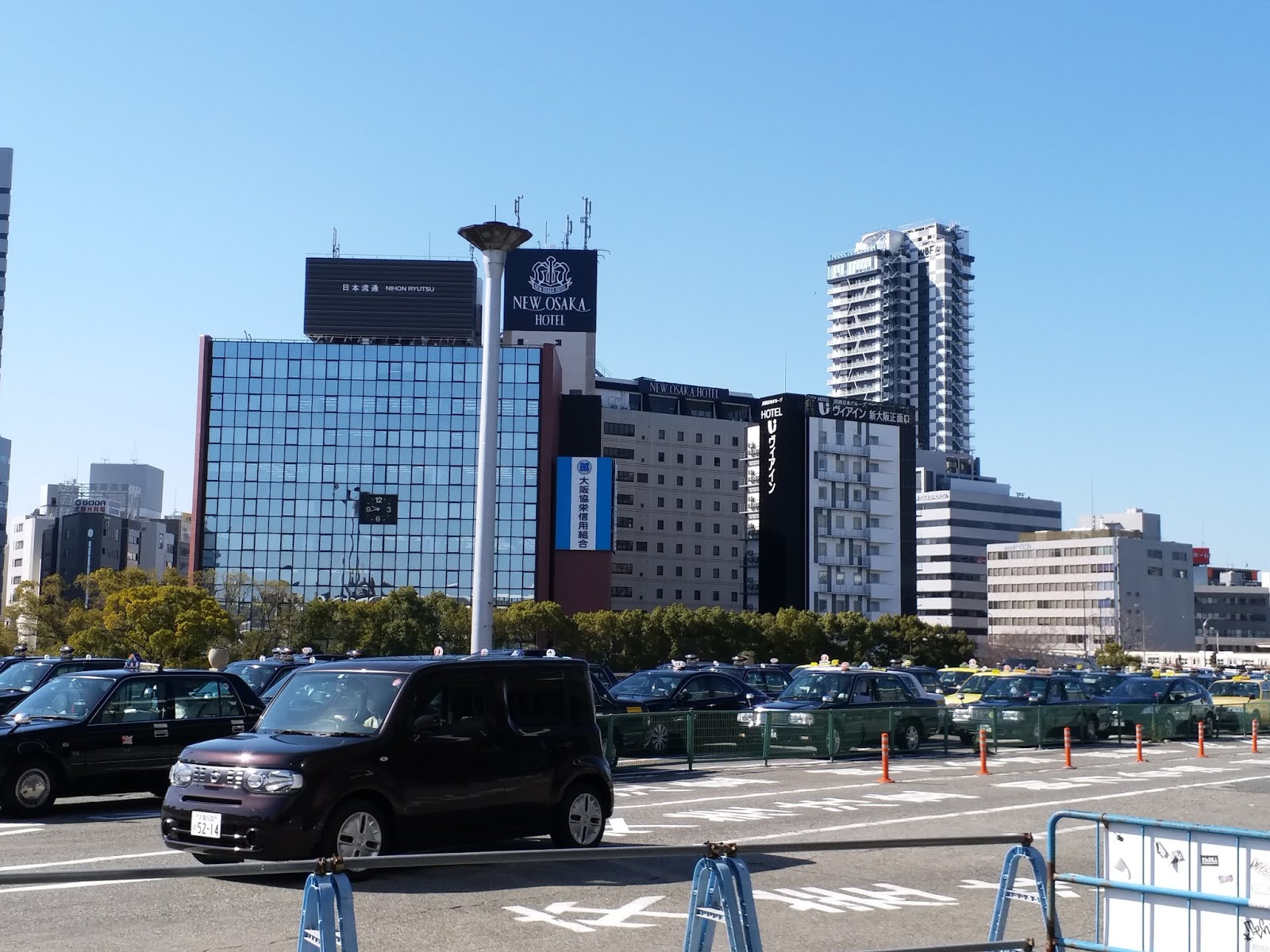

New Osaka in early March
 I arrived at the new Osaka at noon and enjoyed my lunch in a local restaurant. Although new Osaka was a big city, I found that the average price of the food in the restaurants here were not more expensive compared to that in Hiroshima. After lunch I bought a ticket to travel from New Osaka to the Osaka international airport. I returned to Hong Kong after flying for about 4 hours.
My train ticket from New Osaka to the International Airport

The bullet-train has a lot of leg room, big enough I put my luggage

My lunch at New Osaka. It costed me around 1,000 yen, a very reasonable price
Due the pandemic, my trip to Hiroshima was cut short by a few days. At this moment I am still waiting for a refund from my air-line company because they had cancelled my return trip air-ticket.

2020年5月1日 星期五

My visit to Japan 2020 – Hiroshima (4)

 A Yushio-type submarine outside the "Whale of Iron Museum" = JMSDF Kure Museum 
On the 8th of March, I visited Kure (). Kure was a small town famous for its harbour (and its warship building ability before WWII). I went there from Hiroshima (広島) downtown by bus which took about 45 minutes to arrive. In fact, from Hiroshima downtown one could also travel to Kure by JR or by ferry. After alighted from the bus I walked south towards the shore region of the city where both the Yamato Museum (大和ミュージアム) and the JMSDF Kure Museum were located.


Location map of Yamato Museum and the JMSDF Museum


It was a 5-minute walk from the bus stop (or the JR station) to reach these two museums. En-route you would go pass a tourist information service center. It was a nice place to stop-by to collect some information leaflets about Kure city. Upon arriving at the harbor, the first thing that caught your eyes was a huge submarine parked on-land. This was the “Whale of Iron Museum”.

East side entrance of the JMSDF Kure Museum
The “Whale of Iron Museum” was officially known as the JMSDF Kure Museum (海上自衛隊呉史料館). Due to the new virus Covid-19, on that day the museum was closed and I could not go inside. Based on the leaflet issued by the museum, we knew that it had three floors. The submarine on display was standing in the open space next to this museum building. it was a Yushio-type submarine called “Akishio” that was launched in 1985. After its decommission in March 2004, it was put on display on the present spot.


JMSDF Kure Museum closed due to Covid-19


A leaflet of the Yamato Museum


Yamato Museum (in the foreground is an anchor from battleship Mutsu)

The Yamato Museum was located next to the Whale of Iron Museum. It was also closed due to the new virus. The Yamato Museum printed a leaflet to introduce Kure city in the following words “After the establishment of the Kure Naval Base in 1889 and the Kure Naval Arsenal in 1903, Kure flourished as a naval port city.” About the museum it said, “you can see the design blueprints for Yamato (大和), the largest battleship of all time, including details about its technology and history. The exhibition also features the notes and articles left behind by the crew who went on a special suicide attack mission bound for Okinawa. You can also learn about the life in the city during the war. The air raids on Kure, its postwar reconstruction as a harbor city with peacetime industry, and the history of the present-day Kure as one of the greatest shipbuilding cities in the world. The exhibition features information panels and some preserved documents.”

The 2 museums: Yamato Museum on the right, JMSDF Museum on the left

Inside the Yamato Museum, the most eye-catching was a one-tenth scale model of the battleship Yamato measuring 26.3 meters in length. It was reconstructed to resemble as closely as possible the actual ship based on drawings and photographs. Apart from this model, on display were authentic highly valued items such as Zero fighters, a Kaiten (回天) human torpedo and a Type 93 Torpedo.
A 410 mm gun of battleship Mutsu

Outside the Yamato Museum, several huge military items were also on display in the open air. They were the remaining parts of the Imperial Japan battle ship Mutsu (陸奧) which was sunk in a mysterious explosion in June 1943 in a Japanese navy port. The items salvaged from Mutsu and displayed here included its rudder, an anchor, one propeller, and one of its 410 mm gun.
Imperial Japan Battleship Mutsu in 1936
Next to the Yamato Museum, there was a building called the Kure Port Observatory (呉みなと展望台) that one could enjoy the Kure harbor view where a few naval ships were anchored. Inside this building a few dozen photos on the history of Kure were on display, including a photo of the battleship Yamato taken on 20th September 1941 when it was still under construction.
Battleship Yamato under construction in  1941 in Kure

Kure harbor view in early March 2020


2020年3月24日 星期二

My visit to Japan 2020 – Hiroshima (3)

The Hiroshima Sighting Bus Advertisement
A Sight-seeing Bus
On the 7th I took a sight-seeing tourist bus to tour around the major sight-seeing spots in Hiroshima downtown. The trip was free because it was covered by the 4-day pass that I purchased. The bus waited for tourists at the Hiroshima Station (広島ステーション) for drop-in tourists. I took the 9.00 am bus and the trip ended in slightly less than an hour.

There are four sight-seeing bus routes: orange, green, lemon and blue

This bus had four routes named after four colors: orange, green, lemon and blue. I took the orange route which went through 9 tourists’ sites in Hiroshima downtown. The most valuable of this trip was that it showed me the location of the Manga Library (Hiroshima City Museum of Contemporary Art 現代美術館). The library was up the hill and could be a little bit difficult for tourists to travel there. There were a few Arts Museums in Hiroshima downtown, be care not to confuse them with one and other.
A notice on the clinic door requests all visitors to wear masks

In order to check out how the general public in Hiroshima reacted to the new virus. I tried to peep into one local clinic. I noticed that the clinic had put up a poster in the entrance to remind its clients to wear masks.


Fuji Fresh Food Market


Dekopon
I spent some time in a local supermarket, the Fuji Fresh Food Market to buy fruits. Other than the apple from Aomori prefecture, I found a fruit that also had sweetness of 13 degrees: Dekopon (デコポン). Dekopon was a seedless and very sweet hybrid citrus fruit developed by the Japanese in 1972. Dekopon was distinctive due to its sweet taste, large size and the large protruding bump on the top of the fruit.


The oyster I bought and pan fried
About the specialty (名物Meibutsu) of Hiroshima, I think oyster would be one of them. I bought some local oysters and pan fried them in my apartment. Although the size was small, the taste was good. The Fuji Fresh Food Market also sold fried oyster. The taste was also good.
An oyster set advertisement seen in Hiroshima downtown


2020年3月19日 星期四

My visit to Japan 2020 – Hiroshima (2)

The 4-day Tourist Travelling Pass that I  bought

On the 5th of March I flied from Hong Kong at around 9.00 am to Hiroshima and arrived there in less than three hours. The Hiroshima airport was very small. After finishing all the checking formalities, at the airport information counter I bought a bus pass. It was a 4-day bus pass that costed me 4500 yen. The most valuable part of this pass was that you could immediately use it to enter Hiroshima downtown by limousine bus that took about 50 minutes to travel. This trip alone would cost a traveler about 1,100 yen.
Various types of tourist traveling passes are available for foreign visitors

The bus destination was the Hiroshima Station in downtown. It was an important connection point in Japan regionally. It connected the bullet train from Hakata (博多) in western Japan to Tokyo(東京). Locally, it was a transport loop for the whole Hiroshima city: the streetcars and buses used it as their terminal. One should be careful in not to confuse the Hiroshima Station (広島ステーション) with the Hiroshima-eka (広島駅). The latter was located next to the Hiroshima Station and was only a small local tram station.
A phone card that I bought in Hong Kong
In order to ensure that I could have Wi-fi connection all time in Japan, I bought a phone card in Hong Kong. I costed me Hongkong $55.00 for a 6-day period. There was a bonus: it gave a 20-minute telephone time in Japan. It was easy to install; jump inserted the IC card and turned on the roaming function in the phone.
The noodle shop that I visited
After settling down at my Airbnb accommodation I ventured out to enjoy my dinner at a nearby restaurant. The regular menu of this restaurant was all kinds of Japanese noodles: ramen (ラーメン). In the next morning, I went out by taking a streetcar (i.e. a local electric tram) to visit the A-Bomb Dome. It was a popular place for both local and foreigner visitors. On this day I saw both kinds visitors. One person, a lady, representing an anti-nuke group came here to collect signatures to support their anti-nuke campaign. I also saw a Japanese explained to visitors about the impact of the A-bomb on Hiroshima, probably he drove here everyday by his bicycle. But on that day, the Hiroshima Peace Memorial Museum was closed due to the new virus. It was a disappointment to many visitors including me.
The A-Bomb Dome in Hiroshima


A large notice board explaining the A-bomb incident as a world heritage. A small note was attached to it saying that the museum was closed.

In the afternoon I visited a local supermarket to buy some fruit and food. The high-light of the fruit was the apple from Aomori prefecture (青森県) known as Umappuri (うまっぷリor王林). It had a 13 degrees sweetness. It costed 494-yen (tax included) for a pack of three apples.

The sweetest apple in Japan that I have enjoyed


2020年3月15日 星期日

My visit to Japan in 2020 - Hiroshima (1)


Airbnb advertisement for accommodation in Hiroshima central district

Two weeks ago I visited Hiroshima of Japan for about 8 days starting from 5th March 2020. I planned on visiting the A-Bomb Dome, the Hiroshima Peace Memorial Museum; and in the nearby town Kure to see the Yamato Museum and the Iron Whale Museum (JMSDF). On top of that I planned on traveling by ferry to a nearby island (Miyajima) to see the Itsukushime shine which has its O-Torii partly emerged in the sea water during high tides.

I lived in this building. All its first floor apartments are min-paku

 I choose to live in a min-paku (民泊=みんぱく) in Hiroshima for two reasons. First, it is cheaper than living in a hotel; second there is a kitchen and a washing machine inside, both are important for an overseas stay in a fixed place for over one week. My apartment costed me less than HK$5,000 in total. I booked the min-paku through the Airbnb. The online booking was simple and easy. One point to note is that you should pick the one with a proper licence. 

An accommodation law has been enforced in Japan which demands that all min-paku to register with the authorities and that foreigners have to submit personal details such as passport numbers for record purpose. After booking the accommodation, I book the air ticket on line from the Hong Kong Express. I fly from Hong Kong to Hiroshima airport. I choose the Hongkong Express because it is one of the cheapest: one round trip air ticket is about HK$2500 with one luggage weighted up to 25 kg on top of one hand held luggage up to 7 kg. Also, as a matter of fact, there are not many planes that may fly directly from Hong Kong to Hiroshima.

Hiroshima Airport Homepage. HK Express is at the bottom of the list

This is my second time to fly with this low-cost airline company. One thing to note about low-cost jet is that you are not allowed to eat or drink your own stuff in the plane en route except for those you buy from the plane (you can order it before flying).

This time I do not have a good impression on Hongkong Express because for this trip both my departure day and returning day were changed by this company. My original schedule in visiting Hiroshima was from 3rd March to 15th March. I picked these days some 6 months ago. My departure day was changed from 3rd to 5th by this company about a week before departure. Probably due to the new corona virus, the company had to group travelers of different days together into one single batch in order to save money. My returning trip was even more disappointing. While I was in Hiroshima, the company unilaterally cancelled my flight just a few days before my scheduled return. By e-mail it suggested me to buy a return ticket on my own in Japan, or to postpone my depart date to until April when it would resume its flights to Hiroshima in Japan.

2019年2月14日 星期四

My visit to Tokyo 2018 (16)


On the 30th I visited Shinjuku (新宿) by Metro. According to the Tokyo Travel Guide Shinjuku metro station is surrounded by many electronic stores thay offer lots of choices in buying electronic equipment including personal computers.
 
Shinjuku shopping district
There are also a lot of traditional shops and department stores such as the Isetan (伊勢丹)  which is located at the east exit. At the underground, the Metro is connected to many food stores that offers different variety of food items such as Japanese and western sweets, prepared dishes lunches boxes etc. At the underground, one can walk from the metro station to the Isetan Department Store easily.
Isetan Department Store
The Isetan department store is accommodated in a building of its own with different sales focus on each floor. In the basement of the Isetan building is the food section. In this food section, beside fresh vegetable and dry food, customers can buy seafood, and some of them are swimming inside a transparent water tank. On the ground level of Isetan there is a huge area that promotes cosmetic and health care products. The building’s top floor is a restaurant area and a food corner. There are different types of restaurants, including western style, Chinese style and Japanese style. The building roof is a sitting area which customers can sit down to enjoy their take-away food.
At the west exist of the Shinjuku metro there is a twin-tower government building (東京都庁舎). This government building attracts tourists for two reasons: on the ground floor of the number one building there is the Tokyo Metropolitan traveling information center (東京都觀光情報センター). Tourists will find it very useful as there are a lot of information sheet and booklets for tourists to read and take away. On its 45th floor there is the north and south observation deck (北展望室.南展望室). 
Government building information
The Government Twin-tower building


A view from the 45th floor
The observation deck is 202 meters above ground level. It is open to the public to enjoy a panoramic view of the city free. If the weather is good one can look to the west to see Mount. Fuji at a distance. On this floor there are also souvenir shops and a restaurant. This observation deck is popular and always there is a queue waiting for the elevator to bring tourists up to the deck. A simple security check is done on tourists before they are allowed to enter the elevator.
Tourists line up for security check and the elevator
The restaurant on the 45th floor


2019年2月1日 星期五

My visit to Tokyo 2018 (14)


On the 27th I went to Shibuya (渋谷) by Metro, and from there I walked to Meiji Jingu ( 明治神宮) and the Yoyogi Park  ( 代代木公園 ). Shibuya can be reached by different train lines such as the Tokyo Line, the Den-toshi Line, the Fukutoshin Line and the Hanzomon Line. It is a district famous at least for the statute of a dog the Hachikou ( ハチ公 ) and the five-zebra crossing.


Tokyo Travel Guide

The Tokyo Travel Guide says that Shibuya has one of Tokyo’s most famous tourist attractions and believes that it has one of the busiest intersection in the world. People crossed this intersection from the sidewalks of all directions.
Next to this 5-zebra crossing is a statue of a dog erected in memory of its faithfulness as the dog had waited for its owner’s home coming for many years without knowing that its owner had died. During my visit I saw people lining up to take a photo with this statute. According to the NHK news report made on 23.6.2012, "Hachikou" the dog died on March 8, 1935. NHK also said that on that day Hachikou was found staying in the cold near a bridge of the Shibuya river, and it was carried into the train station. At that time, the dog was 11 years old. For many years, the story had that this dog came to the station trying to welcome its owner who had passed away and this story was reported by the newspaper regularly, and this phenomenon became famous. The train passengers and station employees also found this dog cute and it was said that the baggage storage area of the station had become a popular resting spot for travelers. Since that time Hachikou was being widely loved and regarded as a "faithful dog". The story of Hachikou was in the news also in June 2012, please see my blog dated 23.6.2012.
Hachikou
From Shibuya Metro station I walked to the Meiji Jingu. The Tokyo Travel Guide says that the souls of Emperor Meiji and Empress Shoken were enshrined in this Shinto shine. The shrine was built in 1920 and the forest surrounding it was created thanks to the donation of 100,000 trees by the Japanese.
The Meiji Jingu
At the time of my visit, a marriage wedding was being held and many tourists stopped their sight seeing routines to watch as this small wedding procession passed by.

A wedding procession 

From Meiji Jingu I walked to the Yoyogi park.
A location map of Yoyogi Park
The Yoyogi Park was inside the Meiji Jingu. In Yoyogi Park I saw people came here to relax, to play outdoor ball game etc. and to bike. Some people also took along their pet dogs to enjoy the green environment. I also saw a band getting ready to perform music for the park visitors.