顯示具有 生活片段 標籤的文章。 顯示所有文章

2021年2月12日 星期五

First day of the Lunar New Year, Xin Chou (辛丑) - the year of the Ox

Hong Kong stamp 1973 - Year of the Ox

According to the Chinese Lunar calendar, to-day is the first day of the Year of the Ox: the year of xin chou (辛丑), may I wish my readers a happy and prosperous new Year of the OX. The above photo is memorial stamps issued in Hong Kong in 1973, the year of gui chou (癸丑) to celebrate the Year of the Ox 48 years ago. Time flies. Those stamps were bought by me to send letters. The unused ones were left behind at the bottom of my desk drawer and now become part of my stamp collection.

In China Lunar calendar, a traditional way of counting years is to associate them with a 60-year cycle. It is formed by combining two sets of counters. One is called 10 stems (十干) and the other is 12 branches (十二支).  In total 60 names of the year are made by combining one stems (干) with one branch(支) in sequence, known as the stem-branch (干支) cycle. It is a system for counting and naming the lunar years and it forms a pool of 60 names for 60 years in sequence. jia zi (甲子) is the first year in this 60-year name pool while xin chou 癸丑and gui chou 辛丑are two names from this pool. That means the name of a particular year will repeat itself once every 60 years. Stem (干)  is also known as tian gan (天干) while branch (支) is called dizhi (地支).

On top of that, about branches, 12 animal icons (生肖) are used to represent the individual twelve branches (十二支). To take the year 1973 as an example, it is the Year of the Ox, so after a twelve years period in 1985, 1997, 2009 and 2021 will also be the Year of the Ox. Each one of these 12 animals will repeat itself in a 12-year cycle. Besides ox, there are the mouse, tiger and dragon etc. Therefore, it can be said that the time concept in traditional China is repeating cycles while the western concept is linear.

In Hong Kong, with the National Security Law recently being put in place in 2020, many things have changed.  The pre-1997 days have become more memorable to me now. In particular the years beginning from the 1970s, Hong Kong gradually became one of the Asia Four Dragons in Asia. The small crown icon at the top right corner of the above stamp symbolizes a relatively free and open governance under the British rule.


The Tiangan and Dizhi table

The Ganzhi cycle (note no. 38 and no.50)


Reference

Chinese History – A manual by Endymion Wilkinson, published by Harvard University Asia Center in 2000

2020年5月26日 星期二

My visit to Japan 2020 – Hiroshima (5)

On the 8th March I received an e-mail from my air-line company saying that my air ticket to depart from Japan was cancelled due to Covid-19. It offered me two options: a) to wait in Hiroshima until early April hoping that the new virus in Japan would be over by then, or b) to get a refund. Obviously, I could not stay in Japan for such a long time. To say the least, my Airbnb accommodation booking would not allow me to do so as it would end on 15th. My only option was to buy an air-ticket in Japan by myself. The next day I tried to contact a local traveling agency in Hiroshima and found the JTB. To my astonishment JTB was a travel agent that only sold ANA airline tickets. The staff of JTB even said that ANA flight schedules to Hong Kong were very limited, probably due to the new virus in Japan. They recommended me to try another local travelling agent, the HIS.
I bought my air ticket from HIS
On the 9th I visited the of office of HIS in Hiroshima to buy a single trip ticket from Japan to Hong Kong. I wanted to leave Japan as early as possible in order to avoid a quarantine in Hong Kong. Hong Kong Government had announced that very soon all incoming visitors to Hong Kong would be subjected to a 14-day quarantine. The staff in HIS was very helpful and suggested me to buy the Cathay Pacific air-ticket. I agreed and it took about 2 hours for me to finish the ticket buying process. My found that it was a new experience for the HST staff to receive a client like me. It was a rare case for a foreigner to buy a single trip ticket in such relatively small town like Hiroshima. The paper work was done very slowly. There were many reasons, for example, the staff had to spend some time to sort out how to position my first name and last name (as indicated in my passport) into my ticket buying documents which was designed for the Japanese clients. This air-ticket buying experience reminded my Japanese language learning experience in my university days.

I learned Japanese in the University of British Columbia (UBC). In the classroom in those days, often there were group learning scenarios in which students had to do role playing. The setting of one scenario was inside a travelling company and the students had to play the role of a customer or a staff. Students had to practice using Japanese vocabularies such as days, months, the city names, the means and purpose of traveling, and the payment amount and method etc. Now, in Hiroshima, all things came into live again and my memories came back to my mind.

At that moment, the Japanese government had already announced that the only airport opened to foreigners were Osaka and Tokyo. Although I wanted to fly back to Hong Kong from Hiroshima where I was staying, I had no choice but to pick Osaka as the departing airport. As such, I had to sort out my trip from Hiroshima to the Osaka International Airport.

One strange thing I noted was about the air ticket price, it could rise suddenly at any time because of the pandemic. The Cathay Pacific single trip air ticket that I bought was 64,000 yen before tax and 70, 100 including tax (about HK$ 6,000). Out of curiosity, I checked the price again the next day on the Internet, it had jumped to about 220,000 yen (about HK$18,000). That was unbelievable.

Bullet train time table from Hiroshima to New Osaka
My airplane would leave Osaka for Hong Kong on the 12th at 6.00 pm. I chose the bullet-train as the means to travel from Hiroshima to Osaka. The average time taken for a bullet train would usually be from 1.30 hours to over two hours, depending how many stops it would make en-route. I picked the fastest one which made only three stops en-route and took 1 hour and 27 minutes. I noted that all the carriages of any one bullet-train had been designed into either reserved seat (指定席) carriage which was more expensive, and the non-reserved seat carriage (自由席) which was cheaper. So, tourists had to wait at the right spot at the platform for the carriage. The waiting spots were clearly marked on the platform floor.


New Osaka in early March
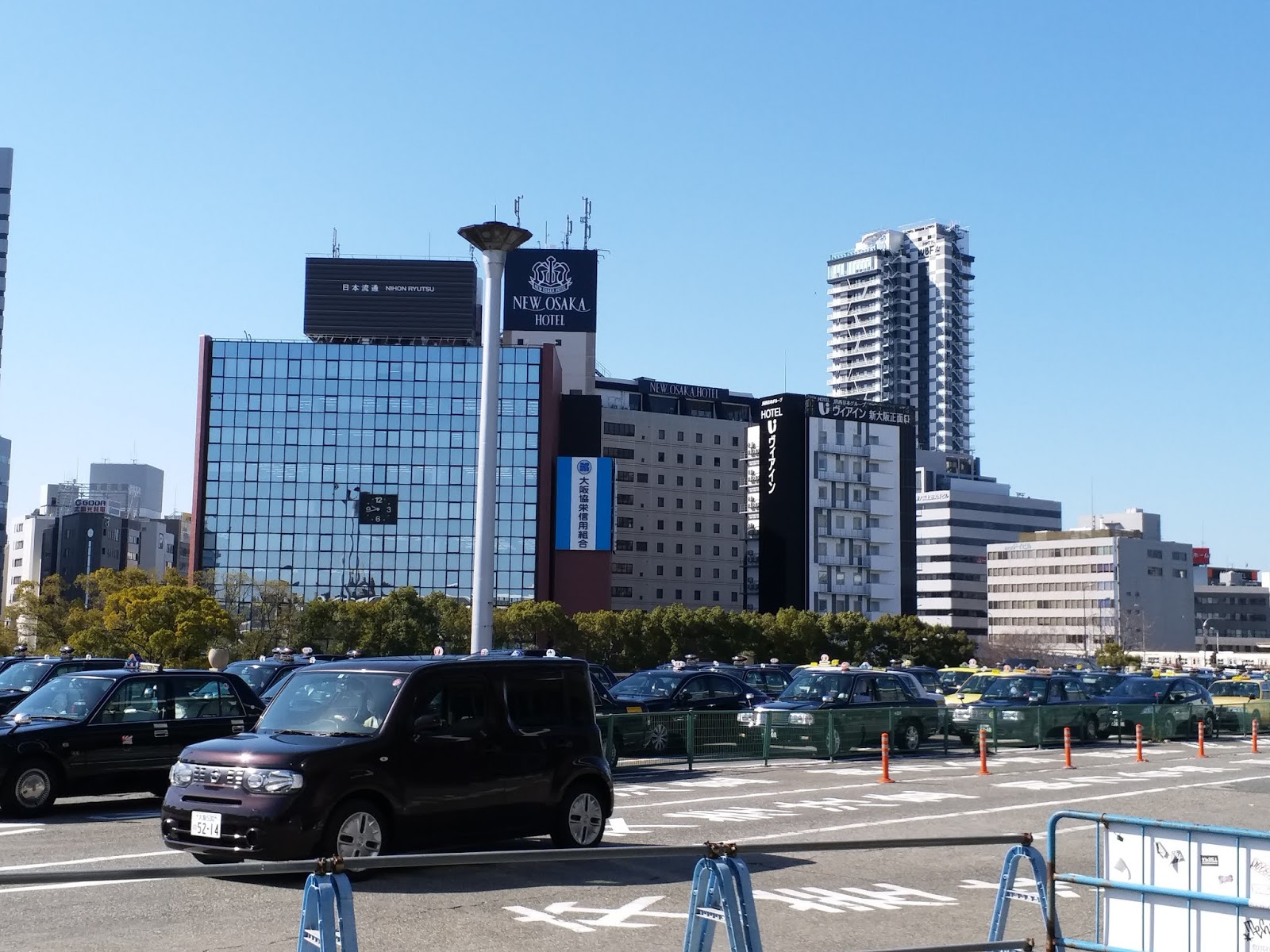
 I arrived at the new Osaka at noon and enjoyed my lunch in a local restaurant. Although new Osaka was a big city, I found that the average price of the food in the restaurants here were not more expensive compared to that in Hiroshima. After lunch I bought a ticket to travel from New Osaka to the Osaka international airport. I returned to Hong Kong after flying for about 4 hours.
My train ticket from New Osaka to the International Airport

The bullet-train has a lot of leg room, big enough I put my luggage

My lunch at New Osaka. It costed me around 1,000 yen, a very reasonable price
Due the pandemic, my trip to Hiroshima was cut short by a few days. At this moment I am still waiting for a refund from my air-line company because they had cancelled my return trip air-ticket.

2019年5月17日 星期五

My visit to Tokyo 2018 (23)


A location map of Kappabashi

On the 6th of November I visited Kappabashi (合羽橋) which is located at the east of Taito District (台東区). This visit marks the end of my trip to Tokyo in 2018. According to the Tokyo Tourist Guide, Kappabashi is “a shopping area with a proud history of over 100 years. This 800-meter-long street is lined up with more than 170 wholesale stores offering Japanese, Western and Chinese tableware; Japanese and Western dessert-making tools; all types of kitchenware; raw ingredients of food, packing supplies; food samples, and more”.
A kitchen-ware shop
A bamboo-ware shop


Several types of shops are particularly popular here: kitchen-ware shops, food model shops, bamboo-ware shops and also a few shops that sell decorations for restaurants. There is also a shop that makes game ticketing machine/vending machine.  I particularly like the shops that sell imitating model of food and dishes, whether it is at full sized or an miniature.

A food-model shop
A Game-machine shop


In the vicinity there is a golden statue of a kappa (河童, river-child) and a plaque was put up in the 15th year of Heisei (A.D. 2003) by a local merchant association to explain the background of this golden statue  which is also known as kawatarō (川太郎, , "river-boy"). As a Japanese folklore creature kappa is known in Chinese folklore as 水鬼 "Shui Gui", Water Ghost. In Japanese Shintō they are considered to be one of many suijin (水神). A hair-covered variation of a Kappa is called a Hyōsube. Hyōsube (兵主部 or ひょうすべ) is a child-sized river monster from Kyūshū that lives in underwater caves. It prefers to come out at night and loves eating eggplants. In many cultures water related deities are used to scare children of the dangers in staying and playing in the water.

A plaque put up in  2003
Kappa statue


        After visiting Tokyo in 2018, I plan on visiting Kyūshū (九州) as the destination of  my next visit to Japan.

2019年5月2日 星期四

My visit to Tokyo 2018 (22)

Ameyayokocho


On the 5th of November I visited Ameyayoko-cho  (アメヤ横丁 ). According to the Tokyo Travel Guide this area is “crowed with stores offering clothes, miscellaneous goods, fresh fish and dried food”. It is located right next to and below the railway lines elevated by bridges above. I entered this street from the direction of the Ueno JR Station.
A map that shows the location of Ue Chyuu
Ameyayoko-cho has long streets with all kinds of shops and restaurants. After walking along the street for about 10 minutes, I reached a junction and the street was branched into the Ameyoko (アメ横) and Ue Chyuu (上中). 
Ue Chyuu
Ameyoko


The shops in these three streets were similar. As a group they formed a marketing region, but it was not an ordinary Japanese market.  It was a China/Philippines/Vietnam/Thai market.  Many SE Asian who lived in Tokyo were seen here buying all kinds of daily commodities, meanwhile some of the food stores here were run by them.  The food price offered here was generally cheap. There were also many small food shops. Some of them had a few small tables and chairs so that customers could sit down to eat after ordering the food. Apart from food stores, there were also some seafood stores, their outlook was just like the ones in Tsukiji (築地) market. There were some clothing shops, shoe shops and some sweets shops that sold candy and the like in a souvenir package. Ameyayoko-cho is a good place for those foreigners who are in a hurry  and would like to do some quick shopping at one single location.
Sea Food Store
Sea Food Store


2019年4月15日 星期一

My visit to Tokyo 2018 (21)

Yananka Ginja


On the 4th of November I visited Yanaka Ginja (谷中銀座 ) in the morning. The Tokyo Travel Guide introduced Yanaka Ginja as a leisure spot and said that “Yanaka together with Nezu and Sendagi is a popular spot for strolling. There many shines and temples. One of the main spots is Yanaka Ginza, which is crowed with both man and women, young an old, as there is everything from old established shops opened since the Taisho era, to modern sweet shops. Many cats also gather at the Yuyake Dandan staircase, which is a hot spot for taking pictures of cats, located at the entrance of the shopping street.” As a cat-lover I want to have a look of the cats.
A Township Guide Map

Nippori Station Map


I traveled to Yanaka Ginja using the Yamanote Line and got off at the Nippori Station (日暮里駅). There was a shopping street in Yanaka Ginja which had many small shops, including food shops from western style restaurants that served toast and coffee to Japanese style food stalls that offered tempura. There were also a shop selling small electrical items, on top of some shops that sold household daily items. While I was strolling along the shopping street, a young local people came towards me to ask in English whether I needed any tour guide service. While I wondered how he could tell that I am a non-local/tourist at a glance, I surprised him by saying in Japanese that “no, thank you; I shall do the sight-seeing by myself.” I stop at a one food stall to buy some tempera. The food’s quality and taste were just ordinary. I think this was a logical outcome as the price of the tempera was super cheap.
 
The tempura of this shop was cheap

There was a shop called “7-Day’s” which sold many small objects such as wood cups and bowls and had attracted many young boys and girls looking for their favourite items. Further down the shopping street there was a  meat shop, the Sendagi honten(千駄木本店) which sold high quality Japanese beef. Right in front of this shop, I saw a man dressed in white selling take-away hot food. At nearby there were chairs where customers could sit down an enjoy the food right away.

Sendagi Honten
The "7-Days" shop

While I was attracted to here by the cats, I was disappointed. I could see only two old and thin cats in the whole street, perhaps the timing of my visit was not right.


2019年4月11日 星期四

My visit to Tokyo 2018 (20)

From Taito looking east one can see the Skytree
A location map of Taito


On the third of November I walked around Tokyo’s Taito district (台東区) and enjoyed some local food as lunch and dinner. I considered it at an in-depth visit to this place. Taito district was a region that tourists seldom visited because there was no tourist attractions. My purpose was to see it first hand to know how the local people bought their daily food.

CCS. Many customers came here by bicycles
CCS had a lot of fresh fruit


In this district, there was a supermarket the CCS (Consumerism Convenience Store) and a chain food store, the Kawachiya ( 河内屋 ) which supposedly to be a food/wine wholesaler. The CCS sold all kinds of daily food items, from vegetable to fruit, from fish to sashimi. I noted that CCS was a popular place for local families to buy their daily food as during the rush hours it was full of customers. One special item of this supermarket was its fresh deep-fry items: fish, chicken and potato etc. There was a fresh sea food corner when one could buy a large piece of tuna and asked the staff to cut it into small pieces for you.
 
Kawachiya. Customers often came here by bicycles
Kawachiya was different from CCS in several areas. It sold mostly packed food or refrigerated food such as meat products.  While there was no fresh fish, vegetable or sashimi, there was a wine corner where one could buy different brand names imported and locally made spirit; and also popular Japanese sake.
In this district several things were noted. I noticed that many people here, both men and women loved riding their bicycles to work or to do their daily shopping. Many drove their bicycles on the pavement instead of on the road. Also, there were a lot of small BBQ food stores selling take-away strings of chicken meat at a price of 100 yen. I also found a small restaurant that customers had to stand while eating, the so called Risshoku(立食). 

I bought rice-omelet from this sore
The rice-omelet is beautiful


There were also many food stores selling take away bento (お弁当) or sushi tray. From some of these local shops I bought one オムライス(rice-omelet) and some sushi.

The take-away sushi that I bought


2019年3月27日 星期三

My visit to Tokyo 2018 (19)

Roppongi Hills  (Source: Toyko Metro Guide)

The Bronze Spider
The High-End Shopping Center


On the second of November I visited Roppongi Hills. There is a multi-complex building designed for different kinds of activities e.g. moving showing and shopping. One of the most iconic symbol here is the bronze spider known as the Maman that was created by the talented late Louise Bourgeois. Often people gathered underneath its legs to take photos. There is an observatory on the Mori Tower roof top where one can enjoy a panoramic view of Tokyo after paying a small fee.
 
A Theater inside the Roppongi Hills
Roppongi Hills is a place to meet international artists and their works. During my visit, the Tokyo international film festival was being held. The region around Roppongi Hills has a lot of embassies coming from different countries. Perhaps because of this reason, there are also a few high-end restaurants here, include a Japanese restaurant and a Chinese restaurant. According to my memory, a Chinese restaurant was offering a lunch that costed about 10,000 yen. Many world-wide famous brand names also open their shops here, the price of their product is beyond the reach of ordinary people. For example, a coat can cost you 388,800 yen.
The price lists of some items
Some of the Clothing on Display


At the basement floor of the building, there is a public place. It is a large  area where one can do reading and eating comfortably using the chairs and tables available there.

2019年3月16日 星期六

My visit to Tokyo 2018 (18)

Ikebukuro Station
Shops in Ikebukuro


On the first of November I visited Ikebukuro (池袋). As shown in a map of the Tokyo Travel Guide copied below, there are at least three different train stations of 3 different Metro lines that stop at Ikebukuro, respectively they are the F09 (Fukutoshin line) (副都心線), the M25 (Marunouchi Line) (丸の内線) and the Y09 (Yurakucho Line) (有楽町線). So, I think Ikebukuro is one of the most conveniently located district in Tokyo. In Ikebukuro, one popular tourist attraction is the Sunshine City, as introduced in the Tourist Guide.
Location map of Ikebukuro (source: TTG)
The Tokyo Travel Guide highlights the Sunshine City as a good tourist attraction. It is located at the east of the Metro stations. Inside this City there is the Sunshine Aquarium. 

My feeling is that Ikebukuro is a busy shopping district with big department stores. I visited the Seibu department store on that day. I am particularly interested in visiting its basement floors as there was a supermarket and a fresh food market with lots of merchandise on display.
Seibu Department Store basement
Seibu Department Store


Leaving the Seibu department store, I visited a Japanese restaurant to have some snacks and I enjoyed the shrimp tempura very much. By the way, it is interesting to note that there were three McDonald’s in the vicinity. So, if you want to date someone at a McDonald’s, be sure to say which McDonald’s is in your mind.
On of the McDonald's
Shrimp tempura